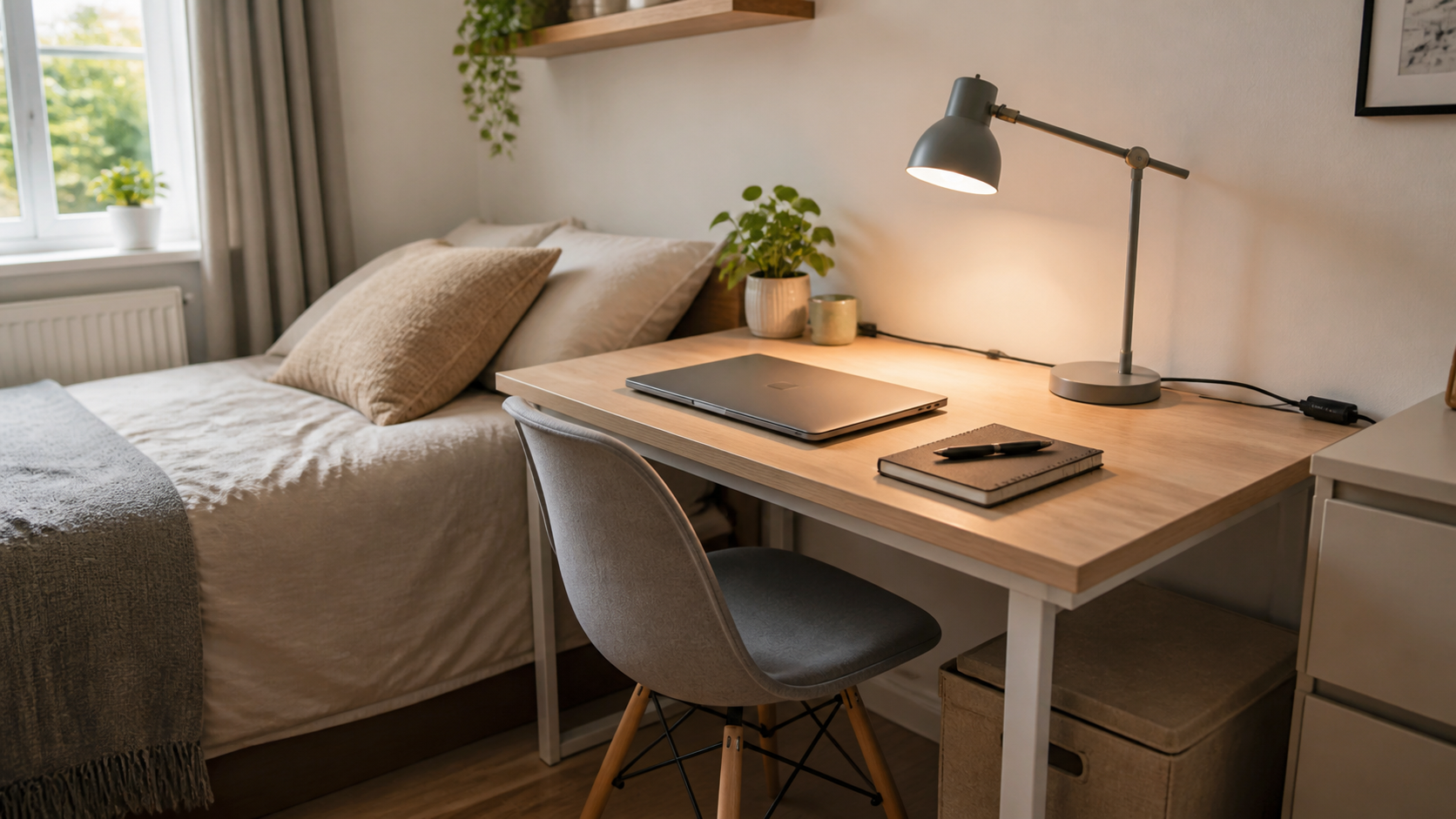
Small Bedroom Office Ideas UK
Affiliate disclosure: This article may contain affiliate links. If you buy through them, we may earn a commission at no extra cost to you.
Prices and availability checked: 14 May 2026. Prices can change quickly, so check the retailer page before buying.
Good small bedroom office ideas uk are less about squeezing in more furniture and more about making the room easy to switch between work and rest. The best setups use a compact desk, closed storage, calm lighting and cables that do not sprawl across the floor.
A bedroom office does not need to look like a corporate workstation. It needs one reliable work surface, a chair that fits under it, a lamp that does not glare, and a quick pack-down routine so the bed area still feels like a bedroom after work.
If you are still choosing the desk, start with our compact desk guide. For budget lighting, use the task lamp under £40 guide, and for cables, use the cable management kit guide.
TL;DR: The best small bedroom office ideas uk start with a measured desk position, enough chair clearance, soft task lighting, hidden storage and a clear end-of-day reset.
- Window wall: place the desk side-on to the window to reduce glare and keep daylight nearby.
- Alcove: use a narrow 70-100 cm desk and wall storage above, not deep drawers below.
- Bed-facing wall: choose a calm furniture-style desk so the room still feels restful.
- Rental room: use freestanding or folding furniture instead of drilled wall desks.
- Shared bedroom: pick closed boxes and a lamp with a focused beam, not bright overhead light.
Measure First, Buy Second
Measure the wall, then measure the working space around the chair. A 100 cm desk may fit neatly against the wall, but it still needs room for the chair to pull out without hitting the bed, wardrobe or door. Leave more space than you think you need, especially if the chair has arms or castors.
Check sockets before deciding the desk position. A tidy bedroom office is much easier when the laptop charger, lamp and monitor cable can reach the wall without crossing the floor. If the only socket is awkward, plan a safe extension lead route and keep it accessible rather than buried under the bed.
Also think about the screen. The HSE display screen equipment guidance focuses on assessing the whole workstation, not just one item of furniture. In a bedroom, that means desk, chair, laptop, monitor, keyboard, mouse, lighting and reflections all need to work together.
Small Bedroom Office Ideas UK: Five Layouts That Work
The best layout depends on where the bed, door, wardrobe and sockets already sit. Do not force a desk into the largest wall if it creates glare, blocks a drawer or makes the chair sit in the walking path.
Use one of these setup recipes as a starting point, then adjust for your actual room. A small bedroom office should feel deliberate, not like a temporary laptop dumped wherever there was a gap.
1. The Window-Side Desk
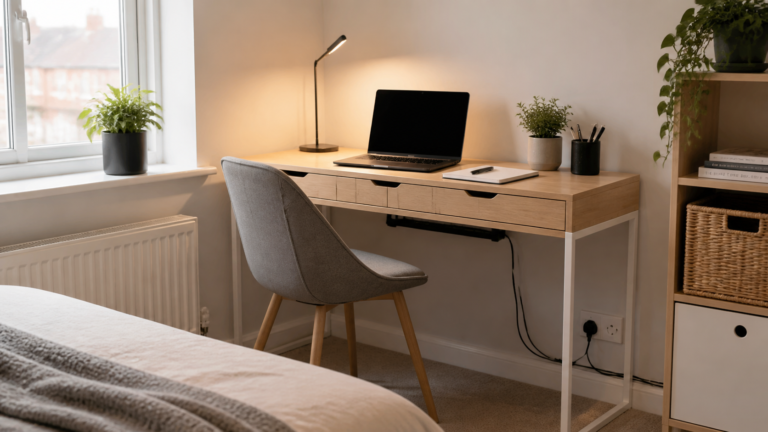
Place the desk near the window but not directly facing it. Side-on daylight is usually more comfortable than a screen in front of a bright window. This setup works well with a compact desk around 100-110 cm wide and a small task lamp for dull mornings or evening work.
Keep the surface light: laptop or monitor, keyboard, notebook and lamp. If the radiator sits under the window, avoid blocking heat or trapping cables behind it. A small cable tray or rear-edge clips can stop the setup looking messy from the doorway.
2. The Alcove Setup
An alcove can make a bedroom office feel built-in without actually installing joinery. Use a narrow desk such as a compact MICKE-style desk, then add one shelf or closed wall cabinet above if the wall can take it.
Avoid filling the alcove with open stationery, folders and boxes. Bedrooms become visually busy quickly. One closed drawer, one lidded box and one wall hook or peg rail is usually enough for daily work items.
3. The Foldaway Desk
A folding desk makes sense if the bedroom is small enough that the chair and desk block movement when left out all day. A freestanding folding desk is easiest for renters because it does not need wall fixings, while a wall-mounted drop-leaf table saves more floor space but needs proper installation.
The trade-off is setup friction. If you need to unpack a monitor, keyboard, lamp and charger every morning, you may stop using the desk. Folding works best for laptop-first work, study sessions or hybrid work where the setup is not used every day.
4. The Wardrobe-Adjacent Setup
If the only free wall is beside a wardrobe, choose a shallow desk and check door clearance. Sliding wardrobes are easier than hinged ones. If doors swing open, mark their arc with masking tape before buying a desk.
This setup benefits from vertical storage. A small drawer unit can block access, but a wall pocket, lidded box on top of the wardrobe or closed basket under the desk can keep work items out of sight.
5. The Dressing-Table Crossover
If the bedroom already has a dressing table, it may be better to improve that setup than add another desk. Keep the surface clear enough for a laptop stand or notebook, then store makeup, cables and stationery in separate closed trays.
The main challenge is height and lighting. A mirror, bright bulbs or beauty lighting can create glare on a laptop screen. Place the laptop slightly to one side and use a task lamp angled down at the keyboard or notebook, not at your face.
Storage That Disappears
Bedroom office storage should hide work quickly. Open shelves look fine on a dedicated office wall, but in a bedroom they can make the room feel permanently unfinished. Use a drawer, lidded box, closed basket or small cabinet instead.
An IKEA ALEX-style drawer unit can work if there is room, but do not force one under a tiny desk if it steals knee space. For very small rooms, one lidded document box and one cable pouch may be calmer than a full drawer unit.
Keep a simple rule: anything used daily can stay near the desk; anything used weekly goes into closed storage. This stops the bedroom becoming a storage overflow for office supplies.
Lighting and Cable Control
Use a focused task lamp rather than relying only on the ceiling light. A small lamp with an adjustable head can light the keyboard and notebook without waking up the whole room visually. Clip-on lamps are useful when the desk surface is tiny.
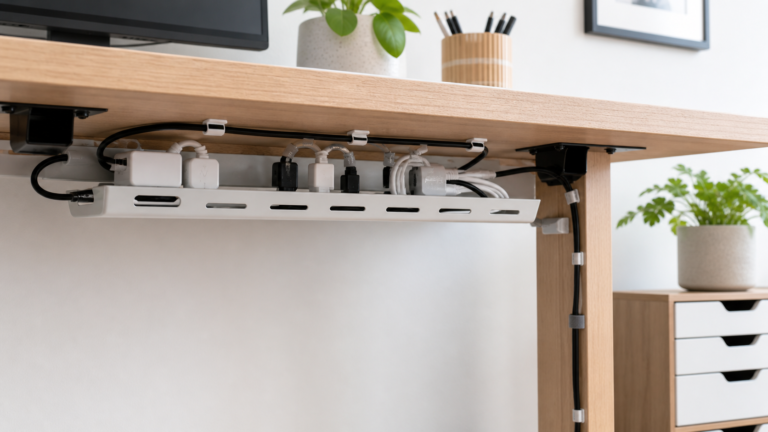
Route cables along the rear of the desk and down one side. If the desk moves or folds, leave enough slack so nothing pulls tight. In a rental, use removable clips and reusable ties before drilling or using strong adhesive.
Keep chargers off the floor where possible. A small tray, cable box or rear clip line makes the setup easier to vacuum around and less likely to get kicked under the bed.
Work/Sleep Boundary
The hardest part of a bedroom office is psychological, not decorative. If the laptop stays open beside the bed all evening, the room can feel like work never ends. Build a two-minute reset: close the laptop, put the notebook away, switch off the lamp and push the chair fully in.
Visual calm matters more here than in a spare room. Choose one quiet colour family, avoid piles of paperwork, and keep the bed side of the room as clear as possible. A small desk can work well if it has a clear off-duty state.
What to Avoid
Avoid oversized desks that trap the chair between the bed and wall. The desk may look productive, but if it makes the room difficult to move around, it will feel wrong after a week.
Avoid open shelving unless you are disciplined about editing what stays visible. Bedroom shelves often collect boxes, cables, bottles and paperwork quickly. Closed storage is less exciting, but it is calmer.
Avoid bright, exposed task lighting at night. A softer lamp angled downward is usually better than a bare bulb or intense LED strip near eye level.
Where to Buy in the UK
IKEA is the strongest starting point for compact desks, drawer units, task lamps and closed storage. MICKE, ALEX, SKURUP and NÄVLINGE-style pieces are easy to combine without making the room feel overdesigned.
Argos is useful for folding desks, compact chairs and quick collection. Dunelm is good for softer bedroom-friendly finishes, clip-on lamps and compact furniture. John Lewis is worth checking when the desk will stay visible and needs to look more like furniture than office equipment.
Wrap-Up
A good bedroom office is not about making the room work harder every hour of the day. It is about creating a desk setup that appears when needed and quietens down afterwards. Measure carefully, choose compact furniture with enough depth, hide the work clutter, and give yourself a reset routine.
FAQs
Where should I put a desk in a small bedroom?
Choose the wall that gives enough chair clearance, socket access and low glare. A side-on window position or alcove often works better than facing the bed or window directly.
What size desk works in a small bedroom?
Around 100 cm wide and 50 cm deep is a useful target for daily work. Go smaller only if you mainly use a laptop and can keep the surface clear.
How do I hide office clutter in a bedroom?
Use closed storage: one drawer, lidded document box, cable pouch or basket. Avoid open shelves full of work items if you want the bedroom to feel calm.
Are foldaway desks good for bedrooms?
Yes, especially for laptop-first or occasional work. They are less convenient if you need a permanent monitor, lamp, keyboard and cable setup every day.
Thank you for reading this post. Don’t forget to subscribe!