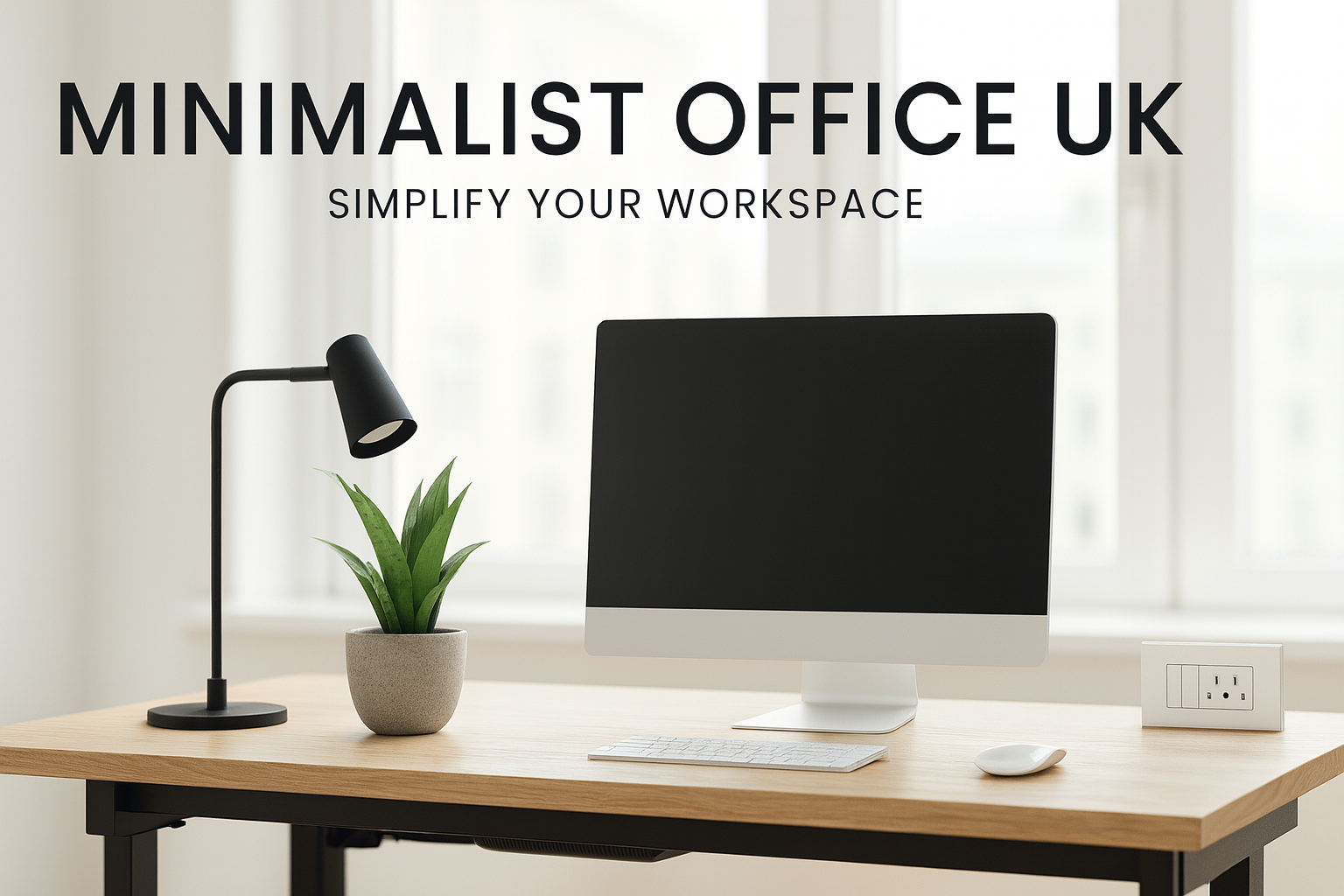
Minimalist Office Decor UK: Clean, Calm & Clutter-Free Ideas
Affiliate disclosure: This article may contain affiliate links. If you buy through them, we may earn a commission at no extra cost to you.
Prices and availability checked: 10 May 2026. Prices can change quickly, so check the retailer page before buying.
If you are searching for minimalist office decor uk ideas, the aim is not to make your desk look empty. The aim is to make the room easier to use: fewer visible cables, calmer lighting, better storage, and a setup that still works on a wet Tuesday morning when you are rushing into a video call.
A good minimalist home office usually comes from five choices: a restrained colour palette, one proper task light, hidden storage, controlled cable runs, and a small number of useful objects on the desk. You do not need a full redesign; most UK home offices can feel calmer with a cable tray, drawer unit, lamp and weekly reset routine.
TL;DR: The best minimalist office decor uk setup keeps the desk surface mostly clear, hides cables, uses warm-neutral task lighting, and stores daily items within arm’s reach but out of sight.
- Small bedroom: compact desk, clip-on lamp, shallow drawer unit, one cable tray.
- Living room corner: fabric chair, closed storage, warm lamp, decor that matches the room.
- Standing desk setup: under-desk tray, monitor arm, single cable run with slack.
- Rental home: clamp-on cable tray, freestanding drawers, no-drill shelves or baskets.
- Low-budget reset: clear the surface, add labels, use hook-and-loop ties, keep one tray for loose items.
Minimalist Office Decor UK: The Simple Formula
The simplest formula is: clear surface, hidden storage, controlled cables, good light and one human detail. That could be a plant, framed print, ceramic mug, wooden tray or fabric desk mat. The mistake is adding five decorative objects before the workspace itself is tidy.
Start with the things you touch every day: laptop or monitor, keyboard, mouse, notebook, pen, lamp and charger. Everything else needs a home. If it does not support the workday or make the room calmer, it should live in a drawer, on a shelf, or away from the desk entirely.
Start With the Problem, Not the Decor
The quickest route to a better room is to fix the thing that makes the desk feel messy every day. If the desk is too big for the room, start with our compact desk guide. If the desk works but the room still feels cluttered, start with cable management before buying decorative storage.
If the problem is screen position, a monitor arm may clear more space than another shelf. If the room looks flat or harsh in the evening, choose a better task lamp before adding prints or plants. For a workstation inside a bedroom, use the small bedroom office ideas guide so the setup can shut down visually at the end of the day.
| If the problem is… | Start here | Why it helps |
|---|---|---|
| The room feels cramped | Compact desks | Gets the footprint right before adding accessories |
| Cables make the setup look unfinished | Cable management kit | Hides the extension lead, spare cable length and daily chargers |
| The monitor dominates the desk | Monitor arms | Raises the screen and frees the surface underneath |
| The desk feels gloomy or glare-heavy | Task lamps | Adds controllable light without relying on the ceiling light |
| The office is in a bedroom | Bedroom office ideas | Keeps the workspace useful without taking over the room |
| The setup feels uncomfortable or unfinished | Desk fit checks | Checks chair arms, desk height and keyboard reach before buying more decor |
Choose a Calm Colour Palette
A minimalist office does not have to be white. In UK homes, softer palettes often work better: warm white, pale grey, muted green, oak, black accents, or a single dark colour such as charcoal. The goal is to keep the large surfaces quiet and let one or two materials do the work.
If you are unsure, choose one base colour, one natural texture and one accent. For example: white desk, oak storage, black lamp. Or: dark grey drawer unit, off-white desk mat, brushed metal lamp. This keeps the room coherent without making it look like a showroom.
Lighting That Actually Helps
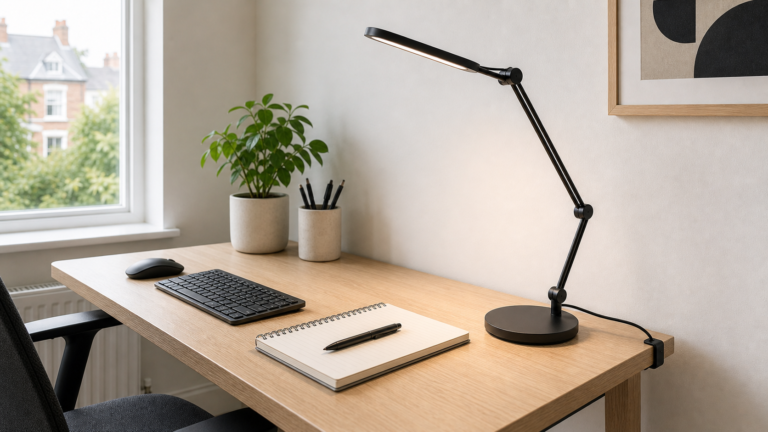
Good lighting is one of the cheapest ways to improve a workspace. A task lamp should light the keyboard, notebook or paperwork without shining into your eyes or reflecting heavily on the screen. In practice, that usually means an adjustable head or arm rather than a decorative table lamp with a fixed shade.
For budget UK options, simple picks include the IKEA SKURUP work lamp, Argos Home Silby LED desk lamp, Habitat Mopsa LED touch desk lamp, or Dunelm’s Imi clip-on task lamp. Choose neutral light for work, then let room lighting create warmth in the evening.
If you are buying from scratch, use the newer task lamp under £40 guide to choose by desk size, bulb type and glare risk. A small base or clip-on lamp is often better than a large decorative lamp on a compact desk.
Hide Storage, Do Not Remove It
Minimalism fails when there is nowhere for ordinary things to go. Pens, spare cables, sticky notes, receipts, batteries and adapters all need a home. A drawer unit is often better than open shelving because it hides visual noise while keeping useful items close.
The IKEA ALEX drawer unit remains a simple option because it has a clean shape and multiple drawers. For smaller setups, the shorter ALEX 36×50 cm drawer unit can sit beside or under a compact desk. Use one drawer for work tools, one for cables, and one for paper so the desktop does not become storage.
Cable Management Comes Before Decor
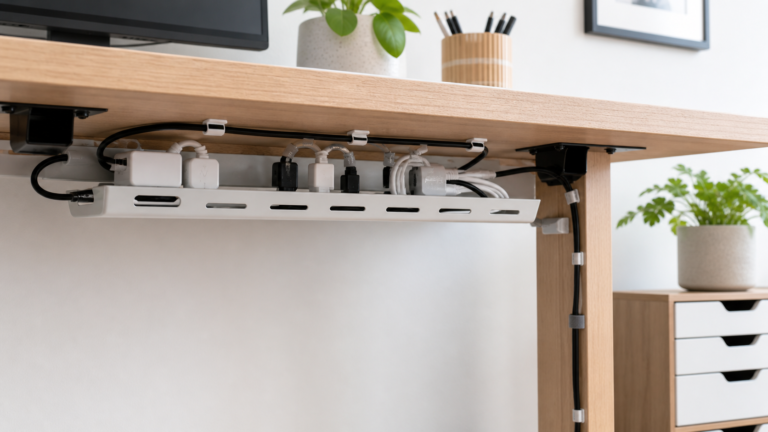
Visible cables make even expensive furniture look unfinished. Before buying plants or prints, fix the cable path. The basic setup is an under-desk tray for the extension lead, a few reusable ties for excess cable, and clips at the back of the desk to stop chargers slipping to the floor.
The IKEA FÖRSÄSONG cable management tray is a useful clamp-on option for renters because it does not need drilling and fits many desk edges. For a standing desk, leave enough cable slack for the highest setting and keep the power strip moving with the desktop if possible.
For a fuller shopping list, use the under-£30 cable management kit guide. It breaks the setup down by cable count, so you can decide whether you need only clips, a tray, labels, or the full kit.
Make the Screen Feel Lighter
A monitor can make a small desk feel heavy even when the rest of the room is calm. Raising the screen on a simple stand or arm clears the surface underneath and gives the keyboard, notebook and lamp more breathing room.
A monitor arm is not automatically the right answer. Check VESA fit, monitor weight, desk strength and wall clearance before buying. The monitor arms under £60 guide is the better next step if you want a cleaner eye-line setup without making the desk wobble.
Desk Surface Rules
A clear desk is easier to maintain if you use zones. Keep the centre for work, one side for light, and one small tray for loose items. If the tray fills, that is the sign to reset the desk rather than add another tray.
Try the 80 percent rule: keep roughly 80 percent of the desktop clear at the end of the day. The visible items should be useful or calming. A lamp, notebook, pen pot and plant are fine; three mugs, loose post and six charging cables are the problem.
Setup Recipes You Can Copy
Small Bedroom Office
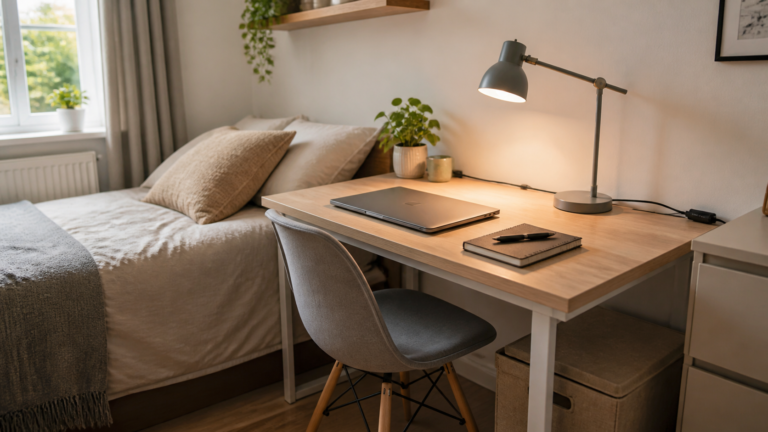
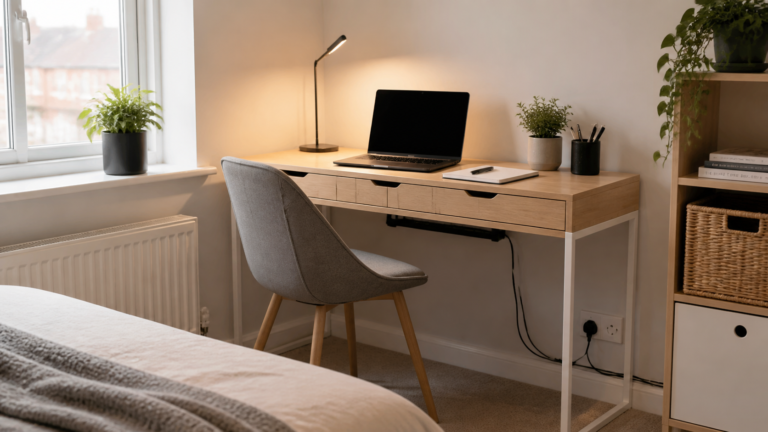
Use a 90-120 cm desk, an armless or compact chair, a clip-on lamp and a shallow drawer unit. Keep colours close to the bedroom palette so the workspace disappears visually when you are not working. Avoid bulky black gaming-style furniture unless the room already leans that way.
For cable control, use a clamp-on tray rather than drilling into rented furniture. A small desk mat can define the work area without adding clutter, and a lidded box or drawer insert keeps chargers and adapters out of sight.
If the room is tight, start with the compact desk guide and then use our small bedroom office ideas for layout choices around beds, wardrobes, radiators and door swings.
Living Room Corner
In a living room, the chair and lamp matter most because they are visible even when the laptop is shut. Choose softer finishes, closed storage and a task lamp that looks like part of the room. A fabric chair can be a better visual choice than a mesh task chair if you only work shorter sessions.
Keep work items in one drawer, basket or cabinet so the corner can return to being part of the living room in the evening. If you need a monitor, consider a monitor arm or slim stand to reduce the visual footprint.
Standing Desk Setup
A standing desk needs stricter cable control because every loose wire is more visible when the desktop moves. Use a tray for the power strip, route one cable down a rear leg, and leave enough slack for the highest position. Keep the desktop light: monitor, keyboard, mouse, lamp and one notebook.
If you are refreshing the whole setup, pair this article with our standing desk under £200 guide. If you already own a desk and are debating a riser, the desk converter vs standing desk guide will help you decide whether to replace the whole desk or keep the surface you have. The cleaner the cable route, the more minimalist the desk will feel.
Floor-Friendly Setup
If your chair rolls across laminate, wood or vinyl flooring, the wheels can undo the calm room quickly. Hard casters can be noisy and harsh on some floors, while softer replacement wheels may suit hard floors better.
Use the office chair mats vs soft casters guide before buying a mat or replacement wheels. Floor protection is not glamorous decor, but it keeps the room looking looked-after.
Where to Buy in the UK
IKEA is the easiest starting point for simple desks, drawer units, cable trays and work lamps. Argos is useful for quick-collection lamps, compact chairs and practical home office basics. Dunelm is better for softer decor, lamps and room-friendly finishes.
John Lewis can be useful when you want better finishes or a calmer range, but it is not always the cheapest route. For a minimalist office, buy fewer things and spend the budget on the items you use daily: chair, desk, lamp, storage and cable management.
Five-Minute Weekly Reset
Once a week, remove everything from the desktop except the monitor or laptop stand. Wipe the surface, empty the tray, put loose paper into one folder, and return only the items needed for the next working day. This is quicker than trying to tidy around clutter.
Then check the hidden mess: cable tray, drawer tops, chair wheels and floor area. If a cable keeps escaping or a drawer is full of random items, fix the storage system rather than blaming yourself for being untidy. Good minimalist decor should make the reset easier, not turn it into a performance.
Wrap-Up
A good minimalist home office is calm because it works. Choose a small number of useful pieces, hide what you do not need to see, and make the desk easy to reset. Once the lighting, cables and storage are sorted, the decor can stay quiet and the room will still feel finished.
FAQs
How do I make a home office look minimalist?
Start by clearing the surface, hiding cables and using closed storage. Then add one task lamp and one or two calm details rather than lots of decoration.
What colours work best for a minimalist office?
Warm white, pale grey, muted green, oak, black and charcoal all work well. Choose one base colour, one natural texture and one accent.
How do I hide cables on a minimalist desk?
Use an under-desk cable tray for the power strip, clips at the back edge, and reusable ties for excess cable. For standing desks, leave enough slack for full height.
What should stay on a minimalist desk?
Keep only daily-use items visible: screen, keyboard, mouse, lamp, notebook and perhaps one small tray or plant. Everything else should have a drawer or shelf.
Thank you for reading this post. Don’t forget to subscribe!